


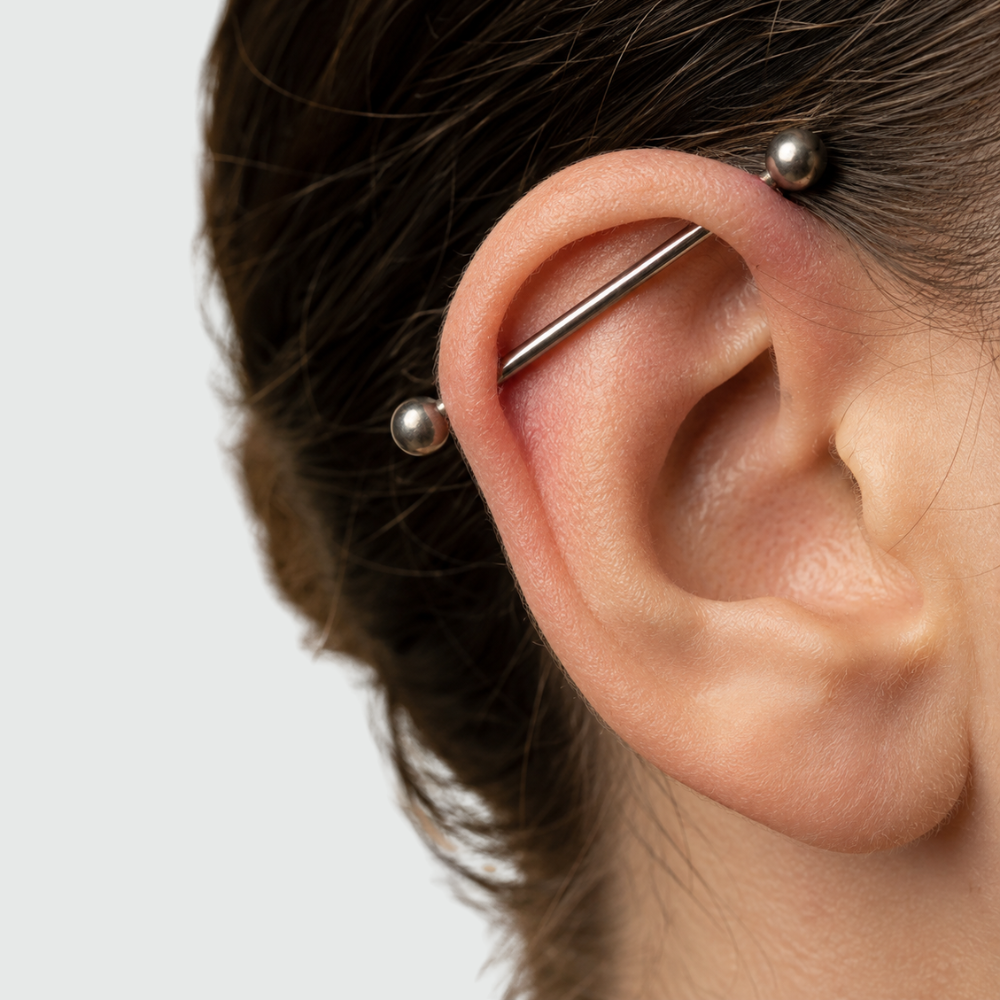
Industrial Piercing
Industrial (often called simply a "barbell") is one of the most recognizable and impressive piercings in the world of ear styling. It involves connecting two separate cartilage piercing channels with one long, straight rod.
The most classic version connects the upper part of the ear (Forward Helix) with its outer edge (Helix). Although it looks phenomenal and immediately catches the eye, Industrial is famous for being uncompromising. It requires a specific structure of the ear, great precision of the piercer and perfect discipline in the healing process. W Piercing Planet We've gathered everything you need to know before making your decision.
Anatomy - Why can't everyone have an Industrial?
In the case of this piercing, anatomy is absolutely essential. You can't beat physics and body structure. To safely wear a straight barbell, your ear must meet two conditions:
- Properly rolled edge of the ear: The labral cartilage must have a clear "rim" on both sides so that there is something to stick the needle into.
- Flat interior (flat ear boat): A straight barbell will go across your ear. The space under it must be flat. If the center of your cartilage sticks out a lot, the bar will put pressure on it. This will cause excruciating pain, abrasions and wounds, and will force you to remove the earring.
Important: If the piercer refuses to perform the classic Industrial after examining your ear - listen to him! Performing this procedure "forcibly" with poor anatomy results in permanent scars.
Does an Industrial piercing hurt?
When choosing Industrial, you must be prepared for the fact that the cartilage will be pierced twice during one treatment.
Pain is felt and is usually rated at 6 to 7 on a 10-point scale. First, the front of the ear is pierced, and a moment later the back. An experienced piercer works very quickly to minimize discomfort, but connecting two fresh wounds with one stiff rod immediately causes a feeling of strong pressure and expansion. After the procedure, the ear will be very red, hot and swollen.
Lobe healing time and care
Industrial healing is considered one of the most difficult in the world of piercing. Two wounds connected by a rigid rod are constantly subjected to mechanical tension with every movement of the ear, smile or chewing of hard food.
- The initial stage of healing (swelling goes down): from 4 to 8 months.
- Complete healing of the canals: from 9 to 12 months (often longer).
The most important rules of survival:
- Beware of hair, glasses and clothes: A long barbell catches literally everything. Be extremely careful when dressing, combing your hair and visiting the hairdresser.
- Daily care: Wash both injection sites (front and back) twice a day with sterile saline. Clean your ear very carefully so as not to move the bar back and forth!
- Absolutely no sleeping on your ear: This is the most important point. Sleeping on your side on a fresh Industrial bed guarantees the formation of painful granulation tissue, pain and, in extreme cases, cartilage distortion.
How to care for a fresh piercing? (Principles of care)
- Don't touch: Avoid touching the earring with dirty hands and refrain from "spinning" it.
- Cleanse regularly: Wash the piercing site 2-3 times a day with sterile saline solution.
- Avoid chemicals: Avoid using hydrogen peroxide, alcohol or antibiotic ointment. They may irritate the wound and delay healing.
- Be careful with your hair and clothes: Make sure that shampoo or conditioner does not remain on the ear after bathing. Be careful when putting on sweaters!
What jewelry for industrial piercing?
In such a tense and demanding piercing, the use of cheap materials is asking for allergy problems.
During healing:
The piercer inserts a straight line Straight Barbell.
- Material: Only the highest quality Surgical Titanium.
- Rod Thickness: Most often 1.6 mm (a thicker rod ensures stability of the wound and less risk of "cutting" the tissue) or less often 1.2 mm.
- Starting Length: Selected strictly to the size of the ear, adding about 3-4 mm on each side due to the huge swelling in the first weeks (e.g. 34 mm, 36 mm, 38 mm).
Downsize: It is absolutely necessary! When the large swelling disappears after 6-8 weeks, the barbell will begin to protrude significantly. An earring that is too long almost guarantees that it will catch on the hair and cause granulation tissue (bubbles) to appear. You need to go to the studio to replace the rod with a shorter one that fits perfectly.
Decorative jewelry for Industrial


- Titanium
- External Thread
Titanium Ball Barbell - Externally Threaded

Choose your option


- Titanium
- Internal Thread
Titanium Ball Barbell - Internally Threaded
Choose your option


- 316L steel
- External Thread
Decorative Steel Barbell - Butterfly
Choose your option

- 316L steel
- External Thread
Decorative Steel Barbell - Cross with Chains
Choose your option


- 316L steel
- External Thread
Decorative Steel Barbell - Heart
Choose your option
Industrial Piercing - Questions and Stories
Can I heal Industrial on two separate earrings (labrets)?
Can I heal Industrial on two separate earrings (labrets)?
We strongly advise against this solution in the case of a classic Industrial. If you insert two separate short labrets to facilitate healing, the tissue will naturally move during regeneration and the angle of the canals will change minimally. Effect? After a year, when you want to insert one straight barbell, it simply won't fit - the channels will not lie in one perfect line, and trying to push the bar in will cause pain and tear the tissue. Industriala heals on a long bar.
I have painful blisters (granulation) at the barbell entrances - what should I do?
I have painful blisters (granulation) at the barbell entrances - what should I do?
Industrial grain is a plague that affects many people. It results almost exclusively from two factors: mechanical damage (frequent hair catching, sleeping on the side) or lack of downsizing (wearing a barbell that is too long and moves constantly). Start sleeping on a pillow with a hole (donut), make sure you have the right length of barbell and patiently wash the area with saline. Don't squeeze the bubbles!
I don't have the anatomy for Industrial - what alternatives do I have?
I don't have the anatomy for Industrial - what alternatives do I have?
If your ear is too flat at the edges or has a protruding earcup, you can choose the so-called Custom Industrial (a barbell bent specifically to the shape of your ear by an experienced piercer) or create two separate piercings (e.g. Forward Helix and regular Helix) and connect them with a decorative chain (Chain Industrial), which is equally effective and much easier to heal.
I have a lump near my earring - what is it?
I have a lump near my earring - what is it?
A small "lump" is most often granulation tissue, which is caused by mechanical irritation (e.g. sleeping on the ear, getting caught in clothes) or a wrong angle of the piercing. Don't squeeze it! Consult your piercer and follow appropriate saline care.


