


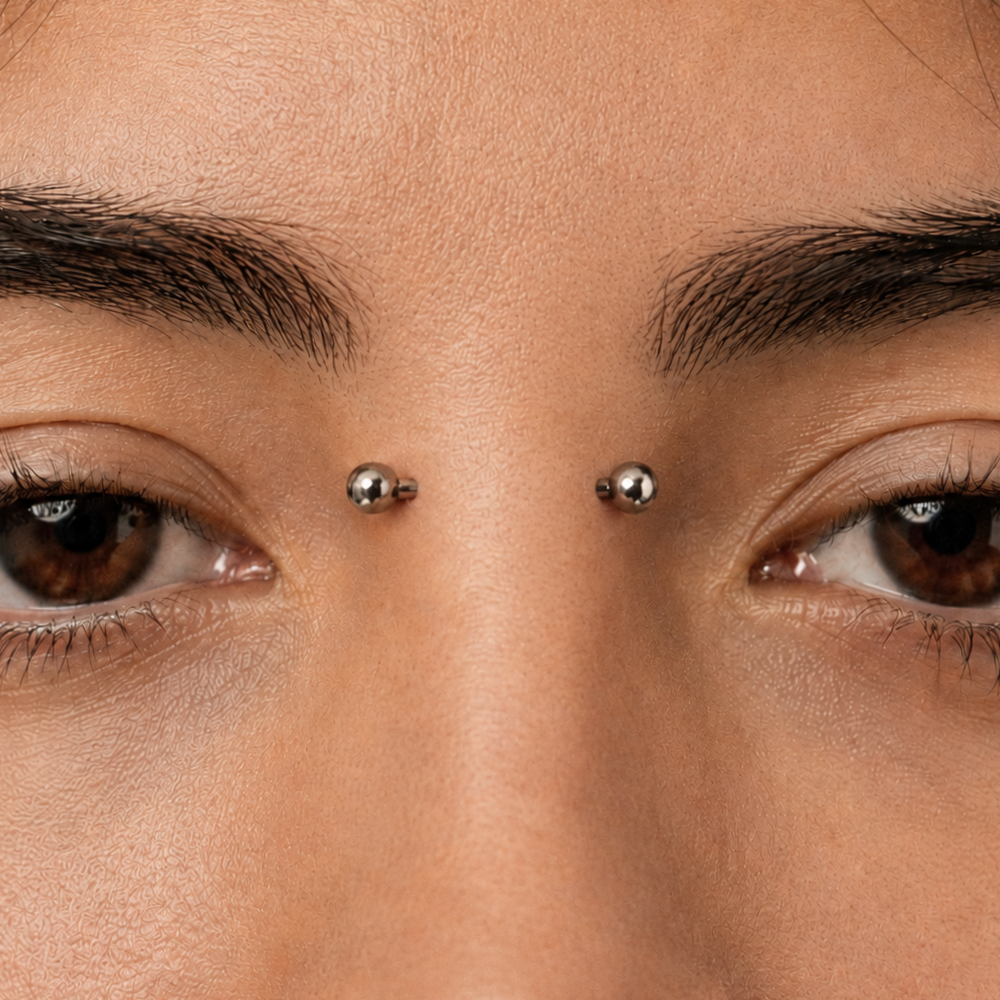
Bridge Piercing
Bridge (often called a nose piercing or Erl) is one of the most expressive and eye-catching types of facial piercing. Placed perfectly in the middle, between the eyebrows and eyes, it gives the face incredible symmetry, a bit of severity and a magnetic character.
However, please note that technically, Bridge is surface piercing (surface piercing). This means that it is very demanding in terms of anatomy and has a higher risk of healing problems than classic Nostril. W Piercing Planet We have gathered comprehensive knowledge for you that will allow you to enjoy this unique earring for as long as possible.
What is Bridge Piercing?
This piercing is performed horizontally, grabbing the fold of skin above the hard nasal bone (at eye level). The needle passes only through soft tissue - We don't pierce bone or cartilage here!
The success of this piercing depends 100% on the structure of your face:
- Appropriate amount of tissue: You need to have enough loose skin at the bridge of your nose that you can easily grip (called "pinchability").
- When the skin is too tight: If the skin on your nose is very tight, thin, or the nasal bone is strongly convex, an experienced piercer will refuse the procedure. Performing the Bridge "forcibly" in such a case is a guarantee of rapid migration (the piercing is pushed out by the body) and the formation of an ugly scar.
Does a Bridge piercing hurt?
Even though the tissue in this place can be thick, the piercing itself is not considered extremely painful. Clients typically rate pain as 3 to 4 on a 10-point scale.
However, you must be prepared for specific body reactions after leaving the studio:
- Severe swelling: The area between the eyes is heavily supplied with blood. Swelling may appear quickly and be very visible.
- Bruises: It is completely normal that bruising may appear around the bridge of the nose (and sometimes even under the eyes) in the days after the procedure. They will disappear on their own after a few days.
- Involuntary tearing: As with other nose piercings, nerve irritation will cause reflex tearing during the procedure.
Bridge healing time and care
Surface piercings on the face require discipline because they are constantly exposed to external factors and facial expressions.
- Initial stage of healing: 2 to 4 months.
- Complete healing: from 6 to 9 months.
The most important rules:
- Key point - Glasses: If you wear prescription glasses or sunglasses, take them for treatment! The piercer must make sure that the frames will not hit, press or catch on the earring. For many people, combining thick frames with Bridge can be very problematic.
- Be careful when dressing: Catching an earring with a blouse worn over the head is the most common cause of painful tears and migration.
- Makeup and cosmetics: Facial care (creams, acids, peels) and makeup (foundations, concealers) must absolutely avoid the area around the fresh piercing! Contamination of the canal with cosmetics is a direct route to infection and the need to remove the jewelry.
How to care for a fresh piercing? (Principles of care)
- Don't touch: Avoid touching the earring with dirty hands and refrain from "spinning" it.
- Cleanse regularly: Wash the piercing site 2-3 times a day with sterile saline solution.
- Avoid chemicals: Avoid using hydrogen peroxide, alcohol or antibiotic ointment. They may irritate the wound and delay healing.
- Be careful with your hair and clothes: Make sure that shampoo or conditioner does not remain on the ear after bathing. Be careful when putting on sweaters!
What jewelry for Bridge piercing?
Material safety is a priority here. W Piercing Planet we want to make customers aware that titanium is the safest material for piercings - this is of great importance, especially in the case of superficial facial piercings, which have a natural tendency to reject.
During healing:
The gold standard is Straight Barbell made of the highest quality G23 Titanium.
(Note: in specific anatomical cases, some piercers may choose a bent barbell, the so-called banana, but a straight barbell is much less likely to cause problems with migration on the flat section of the nose).
- Rod Thickness: Most often 1.2 mm or 1.6 mm (a thicker bar sits better in the tissue and minimizes the risk of migration).
- Length: To start with, the rod must be much longer (e.g. 14 mm, 16 mm) to accommodate the large initial swelling.
Downsize (Shortening the rod): It is absolutely critical! When the swelling goes down (after about 4-8 weeks), the barbell will start to stick out strongly on the sides of the nose. This type of earring will literally hook onto anything. You need to go to a piercer as soon as possible to replace the rod with a perfectly fitting one.
Check out our ASTM F136 Titanium jewelry!


- Titanium
- Internal Thread
Titanium Labret with Ball - with Internal Thread
Choose your option


- Titanium
- Internal Thread
Titanium Decorative Labret - Diamond


Choose your option


- Titanium
- Internal Thread
Titanium Rod - Labret with Internal Thread
Choose your option


- Titanium
- Internal Thread
Titanium Decorative Labret - Flat Cubic Zirconia
Choose your option


- Titanium
- Clicker
Titanium Segment Clicker with Cubic Zirconias Rim - Circle
Choose your option


- Titanium
- External Thread
Titanium Labret with Ball - with External Thread

Choose your option


- Titanium
- Internal Thread
Titanium Banana with Balls - with Internal Thread
Choose your option
Bridge Piercing - Questions and Stories
Does Bridge Piercing make you go cross-eyed?
Does Bridge Piercing make you go cross-eyed?
This is one of the oldest and funniest myths in the world of piercing! Bridge piercing does not in any way cause strabismus or damage the optic nerves. For the first few days after wearing the jewelry, you may subconsciously "peek" at the new balls between your eyes as your brain registers the new object in your field of vision, but after a very short time you stop noticing it completely.
Does Bridge Piercing leave a large scar?
Does Bridge Piercing leave a large scar?
Unfortunately, as a surface piercing, Bridge has a relatively high risk of migration (pushing the piercing through the body towards the skin surface). If you notice that the barbell bar is beginning to show through the skin, the piercing should be removed immediately. After jewelry is removed (whether due to migration or voluntarily), visible, dot-like scars usually remain on both sides of the bridge of the nose.
Can a flexible barbell (bioplast, PTFE) be attached to the Bridge?
Can a flexible barbell (bioplast, PTFE) be attached to the Bridge?
The use of flexible bioplastic or Teflon rods during healing or as permanent jewelry is strongly discouraged. These materials are subject to micro-damage, become porous and absorb bacteria and body secretions. For safe healing and long-term wear, only highly polished surgical titanium (Grade 23) should be used in Bridge piercings.


